A Welcome and a Definition

Culture Vulture: "A person with a strong, sometimes obsessive, interest in the arts." Culture Vultures spend a lot of time observing the world. This is where those observations come out.

Sunday, August 29, 2010

Gorey-ness


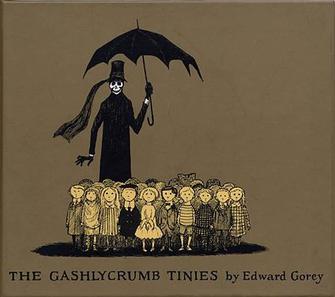
Sorry for the lack of updates lately. Life has been a little out of control lately. However, I did have a moment this weekend to take in the new Edward Gorey exhibit at the Orlando Museum of Art. Before I went, I knew very little about Gorey, other than his popular works such as The Doubtful Guest and The Gashlycrumb Tinies. I went with a friend of mine and several of his artist friends, which always fun for me. I love getting the opinions of people with a more technical eye for art, music, or whatever, as they usually pick up on things I overlook. One person in our group knew a lot about Gorey, so I got some extra insight on the man himself.

Many people tend to think of Gorey's work as dark and Gothic, but I could not help but notice a certain whimsy in what he did. I like that his work never takes itself too seriously. It's not heavy, but there is a certain gravity to it. The exhibits often included the books, so the illustrations had context. Another thing everyone marveled at was Gorey's ability to do the detail in his drawings. His drawings are so small, and all the work looks so fine and delicate. The other interesting thing about the outing was learning more about Gorey himself. To say he was eccentric was to put it mildly. Some interesting facts about Gorey:

*He was a voracious reader. When he died, his house in Cape Cod was filled with volume upon volume of books he had read over the years.

*He was a major recluse, as well as single his entire adult life. Once when asked who/what was the great love of his life, he replied "cats." He always owned cats, and even did illustrations for a volume of T.S. Eliot's Old Possum's Book of Practical Cats.

*He did the costumes and scenery for the 1977 Broadway production of Dracula.

*He was obsessed with the ballet, and attended every production of the New York City ballet while he lived there.

Sunday, August 15, 2010

Sedaris vs. Burroughs


I was having a conversation with friends about going to see David Sedaris when he comes to town to speak next year. I casually mentioned that I wasn't sure I wanted to go, and added I much prefer Augusten Burroughs. My friends basically replied to me that Augusten Burroughs wrote one fabulous book and several terrible ones. Au contraire, I said! This got me thinking about the merits and demerits of both authors.

Sedaris: Now I will give Sedaris credit for basically being the first commercial writer in contemporary times to write these confessional essays/ novels. I think, as a society, we've become more confessional, and his books came out just as we made that leap. Sedaris' work is consistently good. While many people hold up Naked or Me Talk Pretty One Day as his best works, pretty much all his work is on par. However, I think his work can be too staid sometimes. He is very mainstream because he is confessional but it doesn't really offend. I don't think Sedaris really pushes the boundaries often.

Burroughs: Okay, everyone knows Running with Scissors was wonderful (However, don't watch the movie!). I will agree with my friends the point that nothing Burroughs wrote so far has stood up to Running. However, I have to disagree that nothing else he wrote was notable. My second favorite by him is Magical Thinking, which is more a collection of essays than a memoir. I also enjoyed Dry but that may have been because I read it first, before Running. I think that is the biggest problem with Burroughs: he released his best book first, so everything pales in comparison.

One thing I do appreciate about Burroughs is his ability to take some horrific events and writes about them in a such a way that shows the humor in them. He can be macabre, but I think for the most part, it works well. Sometimes his quality does fluctuate (I just barely got through Wolf at the Table), but I think overall his genius separates him from Sedaris.

I know I am in the minority on this, so feel free to leave a comment and respond.

Friday, August 6, 2010

Drama on the Potomac


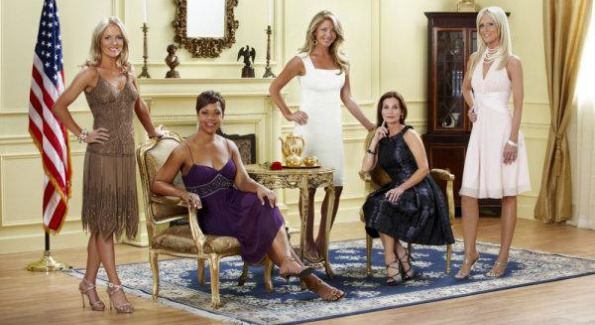
I have been waiting for the arrival of The Real Housewives of DC every since the crashing of the White House state dinner. I mean, seriously, the other Housewives have had drama, but so far this is first show to cause an incident where the Secret Service got involved. I thought I would watch last night's episode and get reeled in enough to keep watching. However, I didn't know I would get hooked from the first episode! So here's my opinions so far:

Mary: I can't say I have a favorite yet, but I think odds are my favorite DC housewife will be Mary. She's equal parts socialite and super mom, and manages to look fabulous doing it all. She had some funny moments last night, including getting drunk at her own birthday and going on to Stacie about integrating salons! She should be fun to watch.

Stacie:
Stacie seems cool, but I didn't get a good read on her role in the show. I like Stacie so far, but I don't know if that will last.

Cat: Cat, the newcomer to DC, did not come across very well her first episode. He acted snooty at the polo tournament, and bashed Obama (also her husband's boss) to a room of black people. Also, some of her stories didn't quite add up: her husband is supposed to be close to her husband, yet he didn't RSVP to her wedding? Also, why was she so insistent about her opinion about Tyra Banks to a man who had worked for her? So far, I don't like Cat.

Lynda: Like Stacie, I am on the fence about Lynda. On the one hand, I can appreciate her love for large black men (like Lisa Lampanelli!) and she did have the funniest line of the show: "I wouldn't show my face at that goat rodeo!" On the other hand, she acted a little snooty in places and seemed overly insistent about another housewife's eating disorder. Which brings me to:

Michaele: I think many people who watched the show last night where curious just to see the antics of Michaele Salahi AKA the woman who crashed a White House state dinner. The rumor is she did it simply to ensure her spot on the show. Just when I thought Bravo had served up crazy in all forms, Michaele seems to be a whole new form of it! Not only was she hugging everyone who came in contact with her, she told more than one person "I love you," including her stylist. In a preview clip, she laments at the White House dinner that she can't hug the president. She's very adamant about not having an eating disorder, despite never really saying what she does eat. The weird thing is I usually cringe while watching the crazies, but I actually like Michaele.

We'll see how the season goes! Should be juicy!

Thursday, July 29, 2010

Cary


Cary and Randolph
I have to admit I've been on a bit of a Cary Grant kick lately. It started when I watched My Favorite Wife on TV about a week ago. That led me to want to reread Marc Eliot's Cary Grant: A Biography and watch a few of his movies courtesy of Netflix.

Now I have loved Grant for several years. I have a picture of him hanging in my bedroom (the only celeb I ever had hanging on a wall in my life.) I think part of me has always wanted to absorb a bit of Grant into my personality. I think many gay men are drawn to Grant because he was the sexy, urbane wit onscreen many hope to be. Also, his romantic movies often reversed the usual sexual roles: he was often the object of desire and was pursued by the female lead. On top of that, gay rumors followed him for decades.

The biography paints a different person than the sexy onscreen persona. Abandoned at a young age by his mother, Grant is plagued by massive insecurities for most of his life. Preferring the company of men to women for at least the first half of his life, Grant seemed unable to make a relationship work with anyone. He was given to fits of loneliness and would often hole himself in his house for days after a serious break-up. Unlike his persona, he was a man of simply tastes. His favorite hobby was going to the horse races.

Ironically, the relationship Grant had that seemed to last the longest was not with one of his wives (he had 5), but with fellow actor Randolph Scott. Scott is mostly known as a B actor who did westerns in the 1950s. He also appeared with Grant in My Favorite Wife. I have always been fascinated by the relationship between Grant and Scott. The book portrays their relationship as multi-layered: more than friends, but not quite committed lovers, they obviously shared a deep connection to one another. Many people think too much was made of the Grant/Scott relationship, that they simply lived together as was customary to many movies stars. However, Grant and Scott lived together for a total of 11 years, and would often be photographed together at events. This happened so often, the studios became supplying them with female "escorts," young actresses to go on the town with them so it looked like a double date.

During his relationship and subsequent marriage to first wife Virginia Cherrill, there was almost a rivalry for Grant's affections between Cherrill and Scott. After Cherrill and Grant divorced, Grant moved back in with Scott and lived with him until just before his 2nd marriage to Barbara Hutton. Scott, meanwhile, had married Marion Somerville, who preferred life at her ranch in Virginia, allowing Scott to continue life in California with Grant. Scott and Grant had a falling out, on top of pressure by the studios about their unusual relationship, and "broke up" around 1940.

Some random facts about Cary Grant:

*Prior to becoming famous, Grant worked as stilt walker with a traveling stage troupe.
* In the 1930s, he had a dog named Archie Leach, his name prior to becoming a movie star.
* His 2nd wife Barbara Hutton was the heiress to the Woolworth fortune. The press dubbed them "Cash and Cary." Hutton was married a total of 7 times, and died penniless in 1979.
*His famous experimentation with LSD therapy was actually a way for him to deal with the emotional detachment issues he had his entire life.
*Grant never won an Oscar for any of his films. In 1970, he was finally honored by the academy with a Honorary Oscar for his body of work.
*There was a 47 year age difference between Grant and fifth wife, Barbara Harris.

Monday, July 26, 2010

Jane Austen's Fight Club


I don't know who did this but I love them for it...

Thursday, July 22, 2010

The Fortunate Ones


As a rule, I don't usually read contemporary novels, outside of a few authors I consistently enjoy. However, I am often drawn to novels about people coming into their own within the context of a very certain time, a very certain place. (I may have mentioned I love movies and books with a strong sense of place.)

In my rereading kick, I recently picked up A Fortunate Age by Joanna Smith Rakoff, a novel that came out about a year ago. The book follows the lives of Lil Roth, Sadie Peregrine, Beth Bernstein, Tal Morgenthal, Dave Kohane, and Emily Kaplan, a group of friends living in New York City and takes place mostly between 1998 and 2002. They all met when they attended and graduated from Oberlin College. Each is born to a prosperous family, and each tries to get away from their own affluence to become musicians, actors, artists, or English professors. The novel captures the jaded prosperity of the late 90s, leading into the sobering up of America with 9/11.

The book opens with the marriage of Lil Roth to Tuck Hayes, a man relatively unknown to the rest of the group. Lil is the first to get married or even embrace any real notion of commitment among the group. While I cannot say Lil is the main character in the book, her disastrous marriage to egotistical slacker Tuck coupled with her strange behavior, often makes her a topic of conversation among the others. The novel also opens and closes with events around Lil. My favorite quote about Lil:

She was a perfect, devoted obsessively attentive friend who could spend hours dissecting Emily's or Sadie's or Dave's problems; who always remembered birthdays and bought too many perfectly chosen gifts; who would meet for coffee at the drop of a hat- and yet over the years somehow those virtues had hardened into something akin to flaws. The light of her affection shined too brightly for any one friend to bear...

Besides Lil, each friend "grows up," moving beyond their own hang-ups and neuroses to finally embrace a more adult life. This seems perfectly set up with pre-9/11 New York City, when people were rather jaded in their own affluence. September 11, 2001 becomes a subtle turning point for all the characters. Sadie says about her life before when she finds herself unexpectedly pregnant: "Everything just feels so pointless. . . . It’s all, like, where are we going to eat for dinner? What movie are we going to see? . . . There’s no urgency to anything. No reason for anything.”

My only criticism for the book that when each character makes the leap into adulthood, it all looks the same: urban NYC parents with spouse, kids and a co-op. It would have been more interesting if one or two of them had grown into something slightly different, yet still resembling a more responsible life. 2 1/2 stars

Friday, July 16, 2010

Gay Boys and Broken Hearts


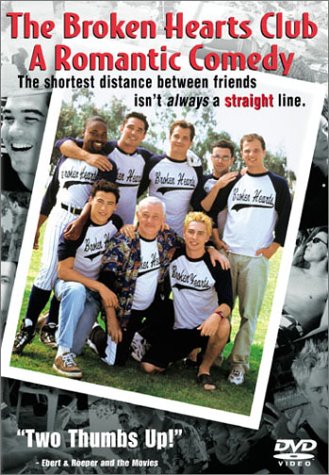
The first time I saw The Broken Hearts Club, I was on the cusp of coming out of the closet. It was a movie that always stuck in my mind a) some of it I could really relate to and b) I found it a little depressing. I tended to avoid it for a long time but finally decided to watch it again.

The movie follows the various storylines of a group of gay men. Each has had his own issues with love and commitment and wanting more from life than simply partying and being gay. The movie was noteworty for a several reasons. First it portrayed gay men slightly different from the AIDS victims and style gurus that had overtaken Hollywood movies in the 90s. Also, the cast was many noteworthy actors, including John Mahoney, Timothy Olyphant, Dean Cain, and then-unknown Zach Braff. Because of all this, I really wanted to like the movie now. On some level, I kind of do. However, it falls short of being gay cinema magic.

There's a telling scene in the movie where Benji (Zach Braff as a bottle blond) is at "gay therapy" AKA the hairdresser, and he mentions this documentary he saw on TV about a tribe of monkeys who live together peacefully all year long until mating season comes, then they tear each to shreds trying to get the best mate. Benji basically equates his group of friends to these monkeys. This mentality is evident when Kevin gets introduced to the group. Kevin is a co-worker of Benji, who brings him around because Benji has a crush on Kevin. Kevin is a "newbie," or newly out. However, Kevin gets stolen away by Cole (Dean Cain), a slightly narcissistic pretty boy actor. Cole drops Kevin (as he does all his other dates) and Kevin ends up hooking up with Dennis (Timothy Olyphant).

In the movie, each of them seems to live life only at the surface, and not really getting invested in real relationships, even with each other. The only constant in everyone's life is Jack (John Mahoney), the older gay man who runs the Broken Hearts restaurant, where they all hang out and some of them also work. Towards the end, they are brought closer by tragedy, ultimately causing Dennis (the main focus of the movie) to reassess his life and make some changes.

I was always taught to give compliments first because it makes criticism easier to take. There are certain scenes and ideas that I liked and could relate. For instance in one scene, Dennis is walking with Kevin, discussing coming out and how his father died just before he came out. Dennis says: "My one regret is that he never knew me." Kevin says "Well, he knew you on some level, I mean..." and Dennis stops him, "No, he never knew me!" That scene hit me because it made me think about how much of my personality I suppressed in order to stay closeted. Even though being gay is not all I am, I would definitely feel the same way. Another sub storyline I enjoyed was Cole's relationship with closeted actor and leading man Kip Rogers (played by Michael Bergin, who I totally forgot about, him and his hotness). I like the jabs at the Hollywood closet.

I think what stops me from embracing this movie completely is how there seems to be no deeper connections among the characters until the end. Each of them seems trapped in their own neuroses and "stuff" and can not let even their friends in deeper than a surface relationship. An example of this is how Jack's partner never says very much, but is always at the baseball games Jack sponsors. The partner is usually dressed completely in purple, so he is referred by the group as Purple Guy. This seems evident of the surface relationships: if they really felt close to Jack, why do they only know his partner as Purple Guy? Also, the ending never comes across as the uplifting now things have changed feeling that I think the movie is trying to convey. I have to resent this portrayal of gay men slightly, showing the usual shallow side of sex and partying that permeated Queer as Folk and many gay movies. I think this movie will always make me feel conflicted. 2 1/2 stars.